AI Body
of Knowledge
The reference framework that settles who decides what when AI is part of the decision, from knowledge area and role down to the AI agent.
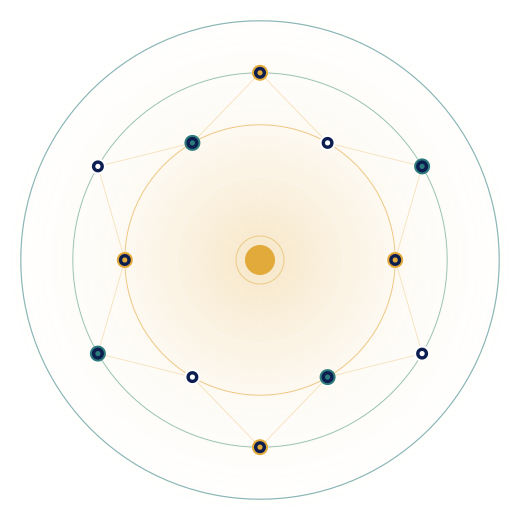

- EU AI Act
- ISO/IEC 42001
- NIST AI RMF
- TOGAF
- DAMA-DMBOK
Governance, architecture and organisation of AI in one coherent framework
Each knowledge area has activities, roles, metrics and references to the standards. New in v1.4: the first 90 days per knowledge area.
From AI Governance (KA1) to AI Literacy (KA13).
With a RACI matrix and one accountable role per knowledge area.
Patterns where agentic and cyber-physical AI fails, with drill scenarios.
Data, control, management and the cognition plane for AI agents.
12 templates
Including seven new blank templates in v1.4, next to the Governance Charter, the model card and the EU AI Act checklist.
Open ArchiMate model
710 elements, 1150 relations and 53 views. Free to download and to explore in SemanticXL.
To the modelNew in v1.4
Evaluation governance (KA6 §6.14), six quality dimensions, an indicative autonomy scale and four new failure modes.
All changesStart from your role
The book has eleven role-based reading paths. These are the five chosen most often.
CIO and board
You have to bring a proposal to the board that holds up. Path: executive summary, KA1 AI Governance, the CIO 30-day plan and the maturity model.
Read the executive summary (pdf)Enterprise architect
You have to fit AI into an existing landscape without breaking it. Path: KA3 architecture, the four planes with the cognition plane, the meta-model and the ArchiMate model you can download freely.
To the ArchiMate modelAI governance officer, CDO, privacy officer
You have just become the owner of something that does not exist yet. Path: KA1, KA9 risk, KA10 compliance, the role model with RACI and the EU AI Act checklist.
Take the Quick ScanCHRO and HR
You have to organise AI literacy and new roles. Path: KA13, the adoption roles AI Ambassador and AI Prompting and Agents Specialist, and the Article 4 evidence in the Toolkit.
Request the ToolkitProject lead and product owner
You are taking an AI system to production for the first time. Path: the 8-phase lifecycle with gate criteria, the sprint checklist and the model card.
Read Start HereAnother reading path
There are eleven reading paths, including the auditor and supervisor, the works council and the AI Agent Governor.
See all reading pathsChoose your edition
Every edition contains the same complete content. You pay once and download the book as a pdf.
Personal edition
The book as a pdf, in English or Dutch.
- 13 knowledge areas, 22 roles and 26 failure modes
- 12 templates, plus the Toolkit through your download link
- Choose the English or the Dutch edition
Team licence
For the governance team working on it together: five readers within one organisation, both editions, one invoice.
- Up to five readers within your organisation
- English and Dutch edition
- Free updates during the first year
Enterprise edition
A one-time purchase for all employees, as the shared reference for your AI governance programme.
- Unlimited users within your organisation
- English and Dutch edition
- Free updates during the first year
- Invoice on company name with VAT specification
Working in the Netherlands? The AI-Act Bewijsdossier is a Dutch workbook for the evidence file, also available as a bundle with the Dutch edition. About the Bewijsdossier (Dutch)
More than five readers or a licence for a partnership? Mail info@ai-bok.nl.
Read first
The sample contains the cover, the table of contents, the executive summary, where to start and the complete knowledge area KA1 AI Governance. Eighteen pages, no e-mail address needed.
Free Toolkit
Five working files alongside the book: modelling conventions, a risk-control library, a calibration kit, procurement clauses and filled example templates. The link is sent by mail.



Jan Willem van Veen
Over 25 years of experience at the intersection of technology, organization and meaning. From the first enterprise architectures in the public sector to the current generation of AI systems. Background in semantic web technology, knowledge graphs and linked data. The scientific paper on the AI-BOK was peer-reviewed and accepted at the EA4AI workshop of CBI & EDOC 2026, to appear in the Springer LNBIP proceedings.
Profile on LinkedInFrequently asked questions
Who is the AI Body of Knowledge written for?
For anyone who has to set up AI governance or account for it: CIO and board, enterprise architects, AI governance officers, CDOs and privacy officers, HR and project leads. The book has eleven role-based reading paths so you read what counts for your role.
How does it differ from ISO 42001 and NIST AI RMF?
ISO 42001 describes a management system, NIST AI RMF describes risk functions. Neither says which knowledge areas an organisation must master or which roles do the work. The AI-BOK adds that layer and refers back to the standards per knowledge area.
How the AI-BOK relates to the standards:
| Framework | What it gives | What it does not give | What the AI-BOK adds |
|---|---|---|---|
| ISO/IEC 42001 | A certifiable management system for AI | No knowledge areas, no role model | 13 knowledge areas and 22 roles that assign the management system requirements |
| NIST AI RMF | Four risk functions: govern, map, measure, manage | No organisational design | Roles, RACI and 26 failure modes per function, with drill scenarios |
| EU AI Act | Obligations per role and risk class | No implementation guide | Mapping of provider and deployer onto the role model, a checklist and Article 4 evidence, including the Digital Omnibus and the harmonised standard EN 18286 |
| DAMA-DMBOK and TOGAF | The data and architecture disciplines | The AI-specific knowledge | The AI layer on top: a gap analysis per knowledge area and an ArchiMate reference architecture with four planes |
| IAPP AIGP | Certification of the professional in four knowledge domains | The organisational side | The operating model that assigns that knowledge inside the organisation: who, what, when |
Does the book cover the EU AI Act, including the Digital Omnibus?
Yes. Since version 1.3 the book incorporates Regulation (EU) 2026/1744: Annex III moved to 2 December 2027, Article 4 as a best-effort obligation, the new prohibitions from 2 December 2026. Version 1.4 (October 2026) adds the harmonised standard EN 18286 and the latest Omnibus updates. The role model is mapped onto provider and deployer.
What is the cognition plane?
A fourth architecture plane next to data, control and management: the place where AI agents reason and decide under an explicit mandate. Mandates, reasoning boundaries, delegation and escalation become objects you can model, assign and audit. It is the core of the peer-reviewed paper at EA4AI (CBI and EDOC 2026, Springer LNBIP).
Are the Toolkit and the ArchiMate model free?
Yes. The Toolkit (modelling conventions, risk-control library, calibration kit, procurement clauses, filled templates) is sent by mail. The ArchiMate model is freely available on the architecture page. The book is the reasoning behind them.
Is the English edition the same book?
Yes. Both editions have the same content and the same 18 diagrams; the English edition is longer because of typesetting. Dutch public-sector crosswalks (VNG, BZK, GEMMA) appear in both as worked examples of mapping a national framework.
Team or whole organisation: which licence?
A single copy is for one reader. The team licence covers five readers in both editions. The enterprise edition covers all employees and fits a governance programme in which the AI-BOK is the shared reference.